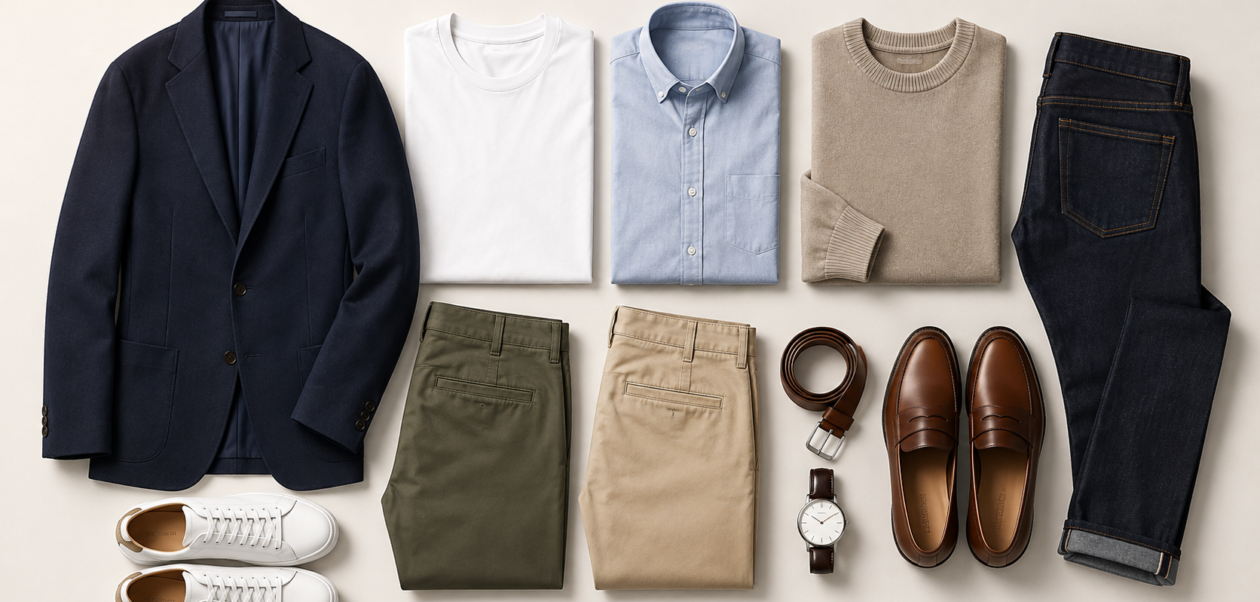
Quick answer
A capsule wardrobe for men is a small group of clothes that work well together. The goal is not to own the fewest possible items. It is to make more useful outfits from fewer random purchases. Start with the clothes you already wear, choose a simple color base, keep fit and comfort first, and add only the pieces that solve a real gap in your week.
What Is a Capsule Wardrobe for Men?
A men’s capsule wardrobe is a focused collection of clothes that can be mixed in many ways. Most pieces should work with several other pieces, so getting dressed takes less thought. A capsule can be small or fairly generous. What matters is that it matches your real life.
This is where many online lists go wrong. A student, an office worker, a frequent traveler and someone who works outdoors do not need the same closet. Climate matters too. A wardrobe for a humid summer will look very different from one designed for a cold four-season city.
That lifestyle-first idea also appears in real community discussions. In a detailed Men’s Capsule Wardrobe journey on Reddit, the writer first worked out why his existing clothes were not working, then built around fit, quality and the style he actually liked. That is a better starting point than buying a pre-made checklist.
Why a Capsule Wardrobe Can Make Daily Dressing Easier
Fewer dead-end purchases. You are less likely to buy a shirt that matches nothing else you own.
More repeatable outfits. A good pair of trousers can work with tees, shirts, knitwear and jackets.
Less decision fatigue. When colors and shapes work together, morning choices become simpler.
Better cost awareness. You can spend your clothing budget on real gaps instead of duplicates.
Easier packing. A connected wardrobe is naturally useful for travel because pieces can be repeated in different combinations.
A practical starting range. Treat the numbers as a guide, not a rule. Original infographic.
How Many Pieces Do You Really Need?
There is no universal answer. Some popular guides use very small numbers. For example, GQ’s men’s capsule wardrobe guide presents a tightly edited set of essentials, while the updated Twelve70 2026 capsule guide suggests building around a compact group of core pieces. Both approaches can be useful, but a number should never be more important than your routine.
A realistic capsule might contain about 15–25 core clothing pieces before underwear, gym gear and special-event clothes. Some people need more. Laundry frequency, climate, school or work dress codes, hobbies and formal events all change the count.
A useful question is not “How low can I go?” It is “Can most of these items create several outfits I will actually wear?”
Step 1: Audit the Clothes You Already Own
Do not start by shopping. First, look at what you wear during a normal two-week period. Put your most-used pieces together. Then look at the items that stay untouched.
- Which trousers do I reach for first?
- Which shirts feel easiest to style?
- Which shoes work for most days?
- Which colors repeat in my favorite outfits?
- What do I avoid because the fit, fabric or styling feels awkward?
This audit shows your real preferences. It also helps you avoid buying a “perfect capsule” for an imaginary version of your life.
Step 2: Define Your Lifestyle Before the Shopping List
| Lifestyle | Prioritize | Optional extras |
| Mostly casual | T-shirts, jeans, chinos, overshirts, sneakers | One smart shirt and cleaner shoes |
| School / college | Easy layers, durable bottoms, weather-ready shoes | One smarter outfit for events |
| Office / business casual | Oxford shirts, trousers, knitwear, blazer | Loafers or Derby shoes |
| Travel-heavy | Light layers, repeatable colors, easy-care fabrics | Packable outerwear |
| Mixed lifestyle | Balanced casual + smart pieces | Seasonal or hobby-specific gear |
Step 3: Choose a Color System, Not a Color Prison
Neutral colors are popular in capsule wardrobes because they are easy to combine. Navy, charcoal, white, cream, olive, denim and brown can create a flexible base. However, a capsule does not have to look colorless.
Pick two or three base colors you already enjoy, then add one or two accent colors. If you love rust, forest green, burgundy or blue, keep them. The point is coordination, not removing personality.
Example palette for easy mixing. Your own colors can be warmer, brighter or darker. Original infographic.
Step 4: Build Around Fit and Comfort
A basic item is only useful when you like wearing it. Focus on comfort, movement and the way pieces layer together. You do not need to chase one fashionable silhouette. Straight, relaxed or more tailored shapes can all work if they suit your preferences and your day.
- Shoulders should sit comfortably without pulling.
- Sleeves should not get in the way of your hands.
- Trousers should allow easy sitting and walking.
- Layers should fit over each other without feeling restrictive.
- Shoes should be comfortable enough for the amount of walking you actually do.
One Reddit discussion about capsule wardrobes also makes a useful point: the concept becomes less practical when it ignores suits, sportswear, seasons or other parts of real life. You can read that broader discussion in r/malefashionadvice’s capsule wardrobe thread.
Step 5: Choose Fabrics for Your Climate
Fabric can matter as much as color. A piece that looks versatile online may be uncomfortable in your weather. Choose materials based on temperature, care and how often you plan to wear them.
| Fabric | Useful for | What to check |
| Cotton | T-shirts, Oxford shirts, casual trousers | Weight, softness, shrinkage |
| Linen | Hot weather shirts and trousers | Wrinkling, transparency, blend |
| Wool / merino | Knitwear, trousers, cooler climates | Care instructions, softness |
| Denim | Hard-wearing casual bottoms | Weight, wash, comfort |
| Blends | Travel and easy-care clothing | Breathability and feel |
A Simple Men’s Capsule Wardrobe Checklist
Use this as a flexible example, not a mandatory shopping list. Start with what you own. Replace or add only when there is a real gap.
Tops
- 2–3 solid T-shirts
- 1–2 Oxford or casual button-down shirts
- 1 relaxed overshirt or casual shirt
- 1 polo if it fits your routine
- 1–2 knitwear pieces for cooler weather
Bottoms
- 1 dark or medium-wash pair of jeans
- 1–2 pairs of chinos
- 1 pair of tailored or smart-casual trousers
- 1 seasonal bottom if needed
Layers
- 1 casual jacket or overshirt
- 1 blazer if you regularly dress smart
- 1 weather layer for your climate
Shoes
- 1 clean everyday sneaker
- 1 smarter shoe such as a loafer or Derby
- 1 optional boot or weather-specific shoe
Accessories
- A belt that works with your most-used shoes
- Simple bag or backpack if needed
- Seasonal accessories such as a cap, scarf or beanie
Five Outfit Formulas That Make the Capsule Work
The value of a capsule is not the item count. It is the number of useful combinations you can make without buying another full outfit.
Five repeatable combinations that can be adjusted for color and season. Original infographic.
For more visual inspiration, this 2026 men’s wardrobe video on YouTube shows how a smaller set of clothing categories can be recombined. Use videos for styling ideas, not as fixed rules for what every person must own.
Seasonal Capsules: Keep the Core, Change the Layer
You do not need to rebuild your wardrobe every season. Keep the main pieces and rotate the layers that respond to weather.
| Season / climate | Keep | Rotate in |
| Hot weather | Tees, lightweight shirts, chinos | Linen, breathable overshirts, lighter footwear |
| Mild / transitional | Core tops and bottoms | Light jacket, cardigan, overshirt |
| Cold weather | Core shirts and trousers | Knitwear, heavier coat, weather-ready footwear |
How to Shop Without Breaking the Capsule
Before buying a new piece, make it pass a simple test. A versatile item should solve a real need and connect to what you already own.
Use these questions before adding another piece. Original infographic.
Also, “quality” does not always mean expensive. Check stitching, fabric feel, care instructions, comfort and how often you expect to wear the item. Buying fewer pieces only saves money when the pieces are genuinely useful.
Common Capsule Wardrobe Mistakes
Buying the whole wardrobe at once. You lose the chance to learn what you actually wear.
Copying someone else’s climate. Heavy layers can be useless in hot weather, while a summer-only capsule fails in a cold winter.
Choosing only neutrals because the internet said so. Versatility should not remove your personal style.
Ignoring laundry and maintenance. A tiny wardrobe is annoying if everything you need is in the wash.
Keeping “versatile” pieces you never enjoy wearing. A capsule should make dressing easier, not feel like a rulebook.
What Real Capsule Wardrobe Users Add to the Conversation
Community posts are useful because they show where neat online checklists meet real life. A long-running casual capsule wardrobe example on r/malefashionadvice explains how the writer chose pieces around his own work environment, weather and preferred footwear. Another recent 2026 discussion in r/capsulewardrobe shows that men’s capsules are not a separate concept; the same basic idea works when the wardrobe is built around the person.
Treat Reddit as experience and opinion, not as a universal fashion authority. The useful part is seeing how people adapt the idea to different budgets, jobs, climates and tastes.
FAQ: Capsule Wardrobe Men
What is a capsule wardrobe for men?
It is a focused group of clothes that work together in many combinations. The goal is to reduce random purchases and make everyday outfits easier.
How many items should a men’s capsule wardrobe have?
There is no official number. A practical core may be around 15–25 clothing pieces, but your work, climate, laundry routine and hobbies can make the number higher or lower.
Does a capsule wardrobe have to be neutral?
No. Neutrals make mixing easier, but you can use accent colors, patterns and statement pieces as long as they work with the rest of your wardrobe.
How many shoes should I include?
For many people, two or three versatile pairs are enough for the core: an everyday sneaker, a smarter shoe and an optional boot or weather-specific option.
Can a capsule wardrobe work for school or the office?
Yes. Change the balance. A school capsule may lean casual, while an office capsule may include more shirts, knitwear, trousers and a blazer.
Should I throw away clothes that are not in the capsule?
No. Store occasional, seasonal or special-event pieces separately if they are still useful. A capsule is an organizing tool, not a reason to waste good clothing.
How often should I update a capsule wardrobe?
Review it when your season, schedule or clothing needs change. There is no need to refresh it just because a new trend appears