
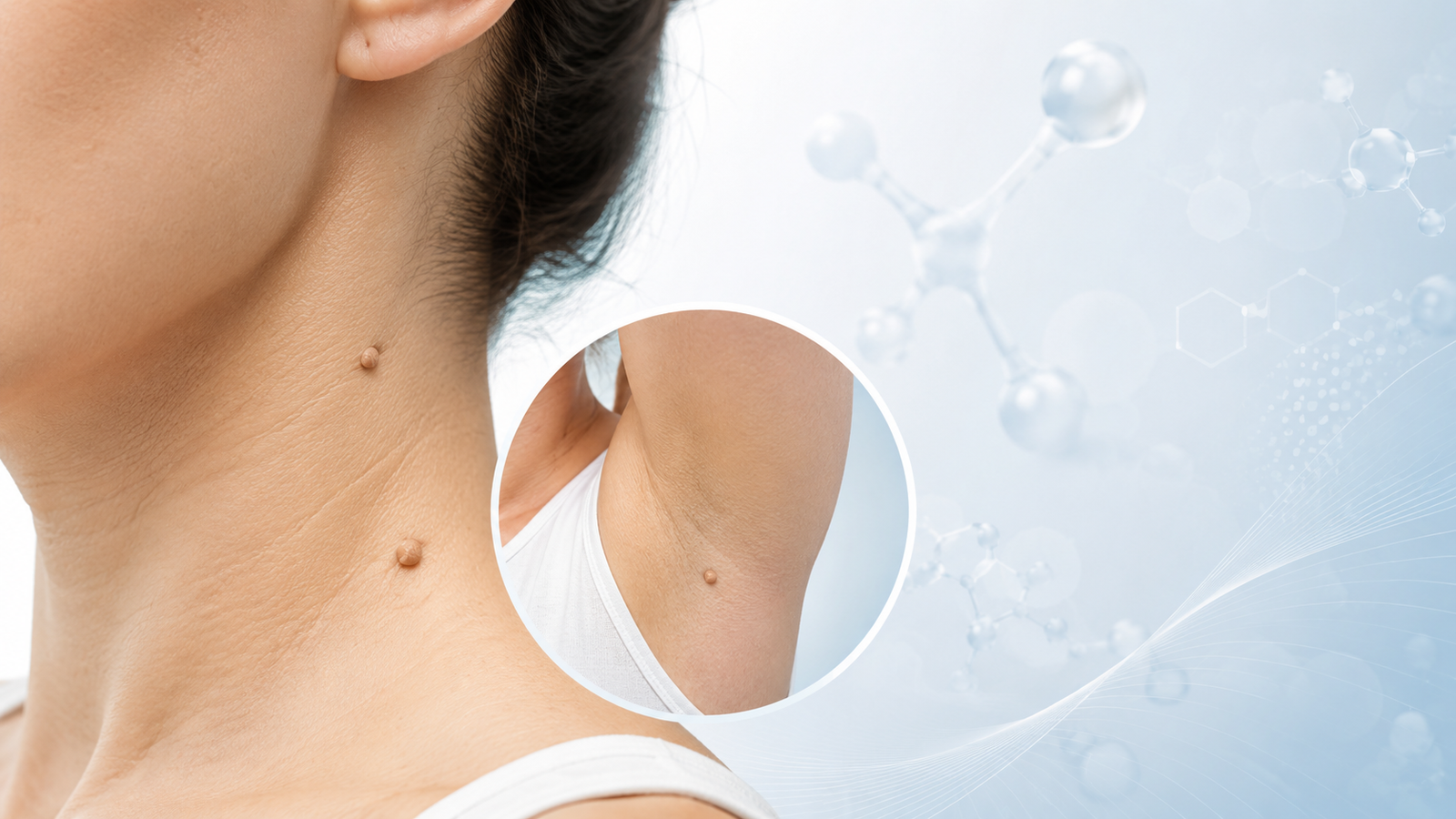
| Quick answer: Skin tags are small, soft, noncancerous growths. There is no single proven cause, but repeated skin friction, age, genetics, pregnancy-related changes, obesity, and metabolic conditions such as insulin resistance or type 2 diabetes are all linked with a higher chance of developing them. |
Medical note: This article is for general education, not diagnosis. A new or changing skin growth should be checked by a qualified healthcare professional if you are unsure what it is.
What Are Skin Tags?
Skin tags, medically called acrochordons, are very common benign skin growths. They are usually soft, small, and attached to the skin by a narrow base or stalk. They can be skin-colored, brown, pink, or slightly darker than the surrounding skin. Most do not hurt and do not need treatment. The American Academy of Dermatology (AAD) explains that skin tags often appear on the neck, eyelids, underarms, groin, beneath the breasts, and other places where skin or clothing rubs repeatedly.
They are also extremely common. A recent StatPearls medical review reports that roughly 50% to 60% of adults develop at least one skin tag during their lifetime. The chance tends to rise with age.
What Causes Skin Tags?
Doctors do not point to one universal cause. Instead, skin tags seem to form through a mix of mechanical friction, age-related skin changes, genetics, hormones, and metabolic factors. Some of these are strong associations rather than direct causes, so it is important not to overinterpret one skin tag as evidence of an underlying disease.
1. Repeated Skin Friction
Friction is one of the clearest explanations for where skin tags appear. The AAD says they commonly develop where skin has rubbed against skin, jewelry, or clothing for some time. That is why the neck, armpits, groin, eyelids, and other skin folds are frequent locations. Cleveland Clinic similarly notes that natural movement and rubbing in skin folds are common features of skin-tag formation.
This does not mean that every area of rubbing will produce a skin tag. It means friction is a likely contributor, especially in people who are already more prone to them.
2. Age and Normal Skin Changes
Skin tags can occur at different ages, but they become more common in adulthood. Medical reviews suggest that changes in skin elasticity and aging may make these growths more likely. Their number can also increase over time.
3. Genetics and Family History
Some people simply seem more likely to develop skin tags than others. Both the AAD and Cleveland Clinic list family history as a risk factor. If close relatives commonly get skin tags, your own chance may be higher as well.
4. Body Weight and Skin Folds
Higher body weight is associated with more skin tags in several studies and medical reviews. One practical reason may be that deeper or more frequent skin folds can create more skin-to-skin friction. However, it would be inaccurate to say that body weight alone “causes” skin tags.

Example of a skin tag (acrochordon). Photo: Xheedv / Wikimedia Commons, CC BY-SA 4.0.
5. Insulin Resistance, Diabetes and Metabolic Health
One of the most searched questions is whether skin tags are related to diabetes. The answer needs careful wording: skin tags do not automatically mean that a person has diabetes. However, having many skin tags has been associated in research with insulin resistance, type 2 diabetes, obesity, abnormal cholesterol levels, and metabolic syndrome.
The AAD’s diabetes and skin guide notes that many skin tags can sometimes be seen in people with type 2 diabetes. The StatPearls review also discusses links between multiple skin tags and insulin resistance. These are associations, not a diagnosis.
If someone suddenly develops many skin tags and also has other reasons to be concerned about blood sugar or metabolic health, it is reasonable to discuss this with a healthcare professional rather than trying to diagnose the cause from the skin alone.
6. Pregnancy and Hormonal Changes
Skin tags may become more common during pregnancy. Hormonal shifts, growth factors, body changes, and increased friction can all contribute. Cleveland Clinic notes that higher growth-factor activity during pregnancy may raise the likelihood of skin tags.
Again, hormones are better described as a possible contributor than a guaranteed cause. Many people go through major hormonal changes without developing skin tags.
7. Is HPV a Cause of Skin Tags?
Some studies have looked for a connection between human papillomavirus (HPV) and skin tags, but the evidence is not strong enough to treat HPV as a confirmed cause. Medical reviews describe the findings as uncertain or inconsistent. In practical terms, a typical skin tag should not be assumed to be an HPV-related wart.
Where Do Skin Tags Usually Appear?
- Neck and neck creases
- Armpits
- Eyelids
- Groin and upper thighs
- Under the breasts
- Sides of the body, abdomen, or back
- Other areas where skin, jewelry, or clothing rubs repeatedly
Are Skin Tags Dangerous or Cancerous?
Typical skin tags are benign and have little to no malignant potential. Most do not require treatment. The bigger issue is that not every bump that looks like a skin tag is actually a skin tag. Warts, moles, and some other skin lesions can look similar.
That is why the AAD recommends getting uncertain growths checked rather than relying on appearance alone. A healthcare professional can usually identify a skin tag with a simple examination.
When Should You See a Dermatologist?
- You suddenly develop many skin tags.
- A growth changes quickly in size, shape, or color.
- It becomes painful, repeatedly irritated, or bleeds without a clear reason.
- It is on the eyelid and interferes with vision.
- You are not sure whether the growth is actually a skin tag.
- You have multiple skin tags plus other concerns about blood sugar or metabolic health.
Can You Prevent Skin Tags?
There is no guaranteed way to prevent skin tags, especially when genetics or age are involved. Reducing repeated rubbing in areas where irritation is common may help some people, but it cannot ensure that skin tags will not form.
If skin tags are linked with broader metabolic risk factors, focusing on general health with guidance from a healthcare professional may be useful for overall wellbeing. It should not be presented as a guaranteed skin-tag treatment.
Should You Remove a Skin Tag at Home?
Home removal is not the safest first choice, particularly if you are not completely sure the growth is a skin tag. Cutting, burning, tying off, or applying harsh products can cause bleeding, skin injury, infection, or scarring. It can also delay the diagnosis of a different type of skin growth.
The AAD guidance on mole and skin-tag removal recommends professional evaluation and removal when treatment is needed.
Frequently Asked Questions
Why am I suddenly getting skin tags?
A sudden increase can happen for different reasons, including friction, body changes, pregnancy, age, or metabolic factors. Because suddenly developing many skin tags is unusual, the AAD recommends medical evaluation.
Do skin tags mean I have diabetes?
No. Many people with skin tags do not have diabetes. However, multiple skin tags are associated with insulin resistance and type 2 diabetes in some studies, so they can be one reason to discuss overall metabolic health with a clinician.
Are skin tags contagious?
No. Typical skin tags are benign growths and are not considered contagious.
Do skin tags go away on their own?
Most remain unless they are removed or occasionally become twisted and fall off. If a growth changes or becomes painful, it is better to have it examined.
Can skin tags become cancer?
Typical skin tags are not considered cancerous. The main concern is misidentifying another skin lesion as a skin tag, which is why uncertain or changing growths should be checked.