
| Quick takeHSBC Mutual Fund reopened three international fund-of-funds schemes to fresh SIPs and other new subscriptions from 18 August 2026. The schemes cover emerging markets, Asia-Pacific ex-Japan and Brazil, with a ₹2 lakh per PAN per month subscription cap. The reopening improves access, but investors should not treat a recently reopened fund or a strong one-year return as a reason to rush in. |
HSBC international funds reopen SIP registrations at a time when Indian investors have had limited access to overseas mutual funds. HSBC Mutual Fund has reopened three overseas Fund of Funds (FoFs) to fresh money from 18 August 2026. The update matters because many international schemes in India have been restricting new subscriptions due to overseas investment limits.
The three schemes are HSBC Global Emerging Markets Fund, HSBC Asia Pacific (Ex Japan) Dividend Yield Fund and HSBC Brazil Fund. Value Research reported that all three reopened to new SIPs and lump-sum investments from 18 August, while LiveMint highlighted the same reopening and the monthly cap.
What Changed on 18 August 2026?
HSBC allowed fresh and additional lump-sum investments, switch-ins, systematic investment plans (SIPs), systematic transfer plans (STPs) and IDCW Transfer Plans in the three schemes. Moneycontrol reported that the permitted investment routes are subject to a ₹2 lakh per PAN per month limit.
This is a reopening, not a new fund launch. HSBC had temporarily suspended subscriptions in these overseas schemes in December 2025. Moneycontrol noted that the fresh access resumed from 18 August 2026.
The Three HSBC Funds at a Glance
| Fund | Main exposure | 1-year | 5-year |
|---|---|---|---|
| HSBC Global Emerging Markets | Emerging markets | 53.6% | 12.8% |
| HSBC Asia Pacific (Ex Japan) Dividend Yield | Asia-Pacific ex-Japan | 40.3% | 15.1% |
| HSBC Brazil | Brazil | 28.9% | 7.1% |
Returns shown above are for direct plans as of 19 August 2026, as reported by Value Research and LiveMint. Past performance does not guarantee future returns.
1. HSBC Global Emerging Markets Fund
This is an open-ended Fund of Funds that invests mainly in the HSBC Global Investment Funds – Global Emerging Markets Equity Fund. According to HSBC Asset Management, the strategy gives investors exposure to emerging-market equities and carries risks such as currency movements, lower market liquidity and higher emerging-market volatility.
Among the three reopened schemes, this fund had the strongest one-year trailing return in the 19 August snapshot at 53.6%. That number is eye-catching, but it describes what already happened. It should not be read as a forecast.
2. HSBC Asia Pacific (Ex Japan) Dividend Yield Fund
This scheme provides access to Asia-Pacific companies while excluding Japan. Its overseas Fund of Funds structure means Indian investors buy units of the domestic scheme, which then invests through an underlying overseas fund. HSBC’s official fund page also carries the standard warning that investment values can rise or fall and that currency changes can affect overseas holdings.
The fund returned 40.3% over one year and 15.1% annualised over five years in the Value Research snapshot. Its regional exposure is broader than a single-country Brazil fund, but it can still move very differently from Indian equities.
3. HSBC Brazil Fund
HSBC Brazil Fund is a more concentrated geographical bet. The official HSBC page says the scheme invests through HSBC Global Investment Funds – Brazil Equity Fund and uses the MSCI Brazil 10/40 Index TRI as its benchmark.
Because the focus is one country, returns can be influenced heavily by Brazil’s economy, currency, commodities, politics and local market conditions. That concentration makes the fund different from a broad global diversification product.
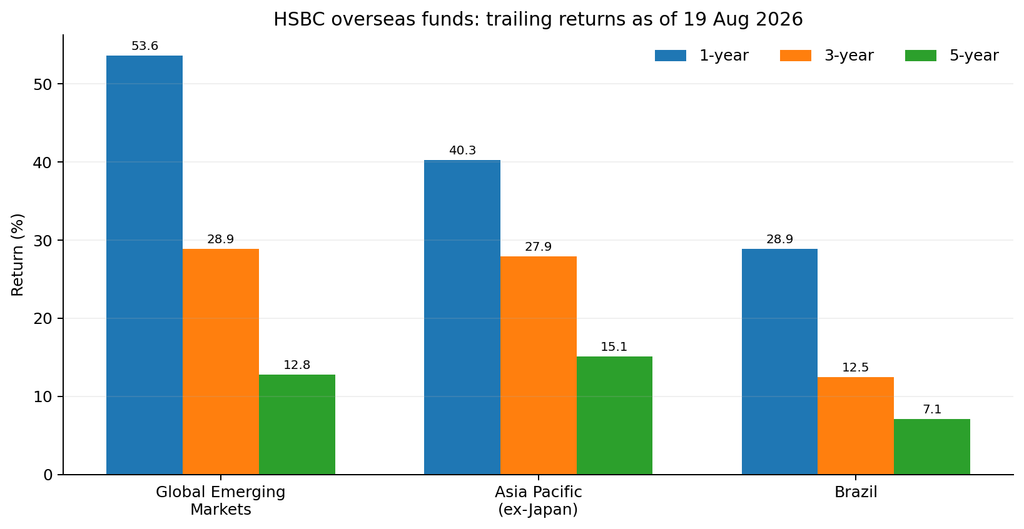
Figure: Trailing direct-plan returns reported by Value Research, data as of 19 August 2026.
Why Do International Funds Keep Reopening and Closing?
The main reason is the regulatory ceiling on overseas investments by Indian mutual funds. When an asset manager has enough headroom, it may reopen a scheme. When the available room becomes tight again, it may suspend new subscriptions.
Current SEBI scheme disclosures continue to refer to an overall mutual fund industry limit of US$7 billion for overseas securities, with a maximum of US$1 billion per mutual fund. Overseas ETFs have a separate US$1 billion industry ceiling and a US$300 million per-mutual-fund limit. SEBI documents also note that schemes may temporarily suspend overseas deployment when limits are exhausted or close to exhaustion.
That is why access can change quickly. A fund being open today does not mean it will stay open permanently.
Important Latest Update: The “Four Open Funds” Snapshot Changed Quickly
A Moneycontrol story dated 20 August described four international funds as open for fresh investments: the three HSBC schemes plus Baroda BNP Paribas Aqua FoF. However, the newer Value Research update published 21 August says Baroda closed its fund to new SIP registrations and lump sums from 19 August. That shows how fast this space can change.
For readers, the practical lesson is simple: check the latest AMC notice before starting a new international SIP. A news article can become outdated within a day or two when subscription limits change.
What Investors Should Check Before Starting an International SIP
- Currency risk: A foreign market can rise while currency movements reduce the return for an Indian investor, or the opposite can happen.
- Market and country risk: Emerging markets and single-country funds can be more volatile than diversified domestic funds.
- Concentration risk: HSBC Brazil Fund depends heavily on one country, while the other two have broader regional or emerging-market exposure.
- Recent-return chasing: A 40% or 50% one-year return can tempt investors to enter after a strong rally. Past returns do not tell you what will happen next.
- Fund-of-Funds costs and structure: These schemes invest through underlying overseas funds, so investors should read the scheme documents and understand the cost structure.
- Subscription uncertainty: Fresh investments may be restricted again if overseas investment headroom becomes tight.
Are These Funds Better Than the Nifty 50?
That is not a useful like-for-like comparison. Moneycontrol noted that the overseas funds had positive recent returns while the Nifty 50 was negative over the same snapshot period, but the funds invest in different countries, sectors and currencies. Their risks and benchmarks are also different.
A better question is whether international exposure fits an investor’s overall portfolio, time horizon and risk tolerance. Overseas funds can add diversification, but diversification does not remove risk.
FAQs
When did HSBC reopen the three international funds?
The reopening took effect from 18 August 2026.
Which HSBC international funds reopened?
HSBC Global Emerging Markets Fund, HSBC Asia Pacific (Ex Japan) Dividend Yield Fund and HSBC Brazil Fund.
Can investors start a new SIP?
Yes. Fresh SIP registrations are among the permitted routes, subject to the applicable monthly cap and current scheme availability.
What is the investment limit?
Reports on the reopening state a ₹2 lakh per PAN per month cap for the permitted subscriptions in these schemes.
Did existing SIPs stop earlier?
The latest Value Research update explains that existing HSBC SIP instalments had continued; the key change now is that fresh SIP registrations and new money are allowed again.
Can the funds close again?
Yes. International fund subscription status can change when overseas investment headroom becomes tight, so investors should check the latest AMC notice before investing.
Bottom Line
The reopening of three HSBC international funds gives Indian investors a fresh route to emerging markets, Asia-Pacific ex-Japan and Brazil. It is useful news for people who were waiting for overseas SIP access, but reopening alone is not a buy signal.