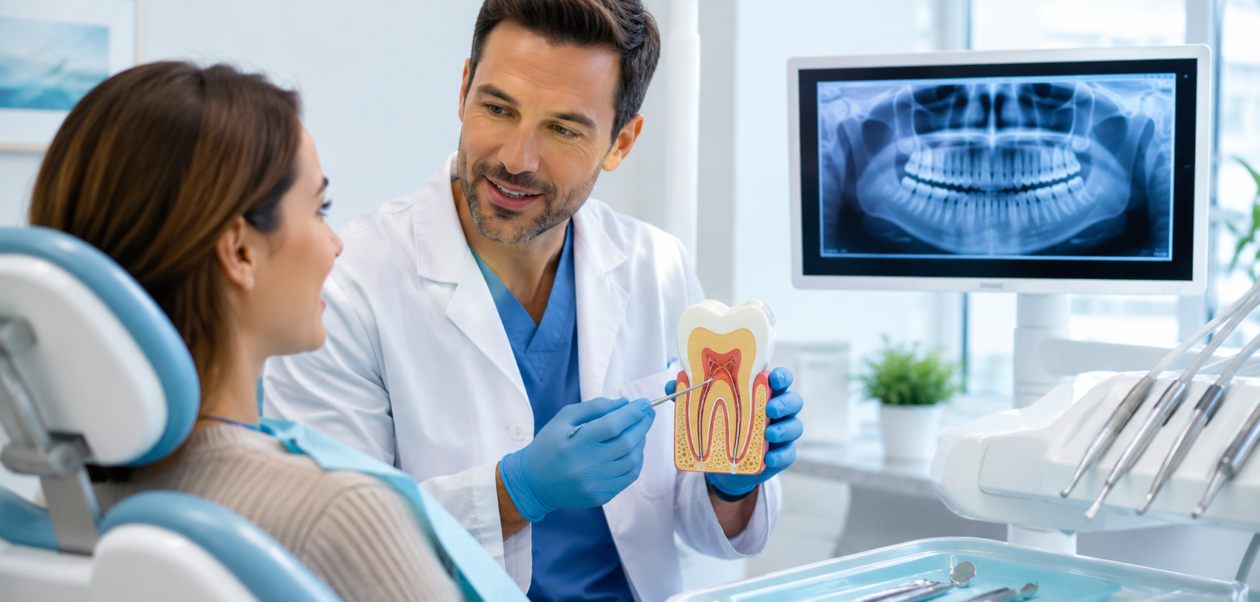
Quick Answer
| No—current scientific evidence does not show that a properly performed root canal is bad for your overall health. A root canal is used to remove infected or inflamed tissue from inside a tooth, clean the canal system, and seal the tooth. Major dental organizations say there is no credible evidence that root canal treatment causes cancer, autoimmune disease, heart disease, or other chronic illnesses. In contrast, leaving a serious tooth infection untreated can lead to pain, abscess formation, bone damage, and tooth loss. |
The question “are root canals bad for your health?” appears often online because old claims about dental infections still circulate on social media and wellness websites. That can make a routine dental treatment sound much more dangerous than the evidence suggests.
Modern root canal treatment is designed to remove infection, not trap it inside the body. At the same time, no dental procedure is completely risk-free. A treated tooth can sometimes fail, become reinfected, or need more treatment. The useful question is therefore not whether root canals are “perfect,” but how their known risks compare with the risks of leaving an infected tooth untreated.
Are Root Canals Bad for Your Health?
For most people who need one, a root canal is considered a safe, evidence-based way to treat infection inside a tooth and keep the natural tooth. The American Association of Endodontists (AAE) states that there is no valid scientific evidence linking properly performed root canal treatment with systemic disease. The NHS describes root canal treatment as a way to remove infection from inside a tooth, clean the space, and fill it to reduce the chance of infection returning. [1][2]
This does not mean every root canal succeeds forever. Teeth can crack, restorations can leak, new decay can develop, or a complex canal can be difficult to clean completely. However, those are treatment and tooth-level complications—not proof that root canals are harmful to the whole body.
What Happens During a Root Canal?
Inside each tooth is soft tissue called the pulp. It contains nerves and blood vessels while the tooth develops. Deep decay, a crack, injury, or repeated dental work can irritate or infect this tissue.
The tooth is numbed. Local anaesthetic is normally used so the area can be treated comfortably.
The dentist opens the tooth. A small access opening allows the dentist to reach the infected or inflamed pulp.
The canals are cleaned and shaped. The damaged pulp is removed and the root canal spaces are disinfected.
The canals are filled and sealed. The cleaned space is filled to help prevent bacteria from re-entering.
The tooth is restored. A permanent filling or crown may be needed to protect the tooth and restore normal function.
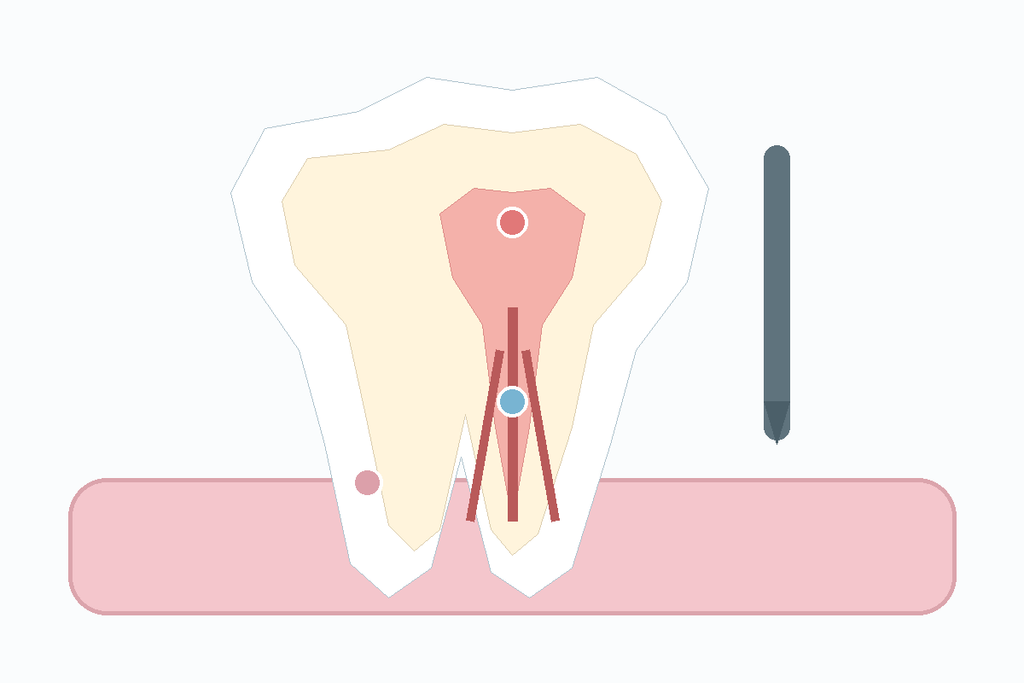
Simple educational illustration of the tooth and root canal space.
Why Do Some People Think Root Canals Are Dangerous?
Much of the fear comes from an old idea called the focal infection theory. In the early 1900s, some researchers believed bacteria left in a treated tooth could release harmful material into the body and cause disease elsewhere.
Those early experiments were performed before modern imaging, microbiology, sterilization, and clinical research standards. Later research did not support the broad claims. The AAE says the old theory is not supported by current scientific evidence, yet versions of it continue to appear online. [1]
Do Root Canals Cause Cancer?
Current evidence does not support a causal link between root canal treatment and cancer. The AAE specifically states that there is no credible scientific evidence connecting properly performed root canal treatment with cancer, including breast cancer. [3]
It is important to separate a scary claim from a proven risk. A personal story, social-media post, or timing coincidence cannot show that one medical event caused another. For a claim as serious as cancer, researchers look for consistent results across high-quality studies and a plausible cause-and-effect relationship. That evidence has not been established for root canals.
Can Root Canals Cause Heart Disease, Diabetes, or Autoimmune Problems?
There is no reliable evidence that root canal treatment itself causes heart disease, diabetes, or autoimmune disease. However, scientists are actively studying a related issue: whether untreated or persistent dental infection can add to inflammation in the body.
A 2022 narrative review in the International Endodontic Journal found emerging evidence that apical periodontitis—an infection and inflammation around the tip of a tooth root—may be associated with systemic inflammation and conditions such as cardiovascular disease or poorer blood-sugar control. The same review concluded that successful root canal treatment may reduce inflammatory burden, while also noting that more high-quality research is needed. [4]
What Does the Latest 2026 Research Say?
A new 2026 review accepted by the Journal of Endodontics looked at longitudinal research on apical periodontitis and general health. It reported that people with this type of root-end infection can show higher levels of certain inflammatory and metabolic markers. The review also reported improvements in several markers after successful endodontic treatment. [5]
This builds on a King’s College London clinical study that followed 65 patients for two years after root canal treatment. Researchers observed improvements in glucose metabolism, short-term lipid measures, and some inflammatory markers after successful treatment. [6]
Important limitation: these findings do not prove that getting a root canal prevents a heart attack or diabetes. They suggest that treating a chronic dental infection may reduce one source of inflammation. Larger studies are still needed before strong disease-prevention claims can be made.
What Are the Real Risks of Root Canal Treatment?
The real risks are mostly related to the tooth and the success of treatment. A root canal can sometimes fail to heal as expected, or a problem can return later.
- A hidden or unusually shaped canal may be difficult to clean completely.
- A filling or crown can leak, allowing bacteria to re-enter the tooth.
- New decay can affect the treated tooth.
- The tooth may crack or fracture, especially if it has lost a lot of structure.
- A persistent infection may require retreatment, endodontic surgery, or extraction.
These possibilities are why follow-up care and a good final restoration matter. If a treated tooth becomes painful again, feels swollen, or develops a new problem, it should be checked rather than ignored.
Is an Untreated Tooth Infection More Dangerous?
Often, yes. If the pulp inside a tooth is infected and cannot recover, doing nothing does not remove the source of infection. The problem may progress to an abscess, damage tissues around the root, or eventually make the tooth impossible to save. The NHS notes that an infected tooth that is not treated with root canal therapy may need to be removed. [2]
This is also why antibiotics are not a substitute for dental treatment in most localised pulpal and periapical problems. The American Dental Association recommends prioritising definitive dental treatment for most of these conditions, while antibiotics are generally reserved for situations where systemic involvement is present. [7]
Root Canal vs Tooth Extraction
| Question | Root Canal | Extraction |
| Main goal | Remove infection and keep the natural tooth | Remove the entire tooth |
| Natural tooth kept? | Usually yes | No |
| Further dental work | Often a crown or permanent restoration | May need a bridge, denture, implant, or no replacement depending on the case |
| Best option? | Depends on whether the tooth can be predictably restored | May be better when the tooth is badly cracked, non-restorable, or has a poor prognosis |
Extraction is not automatically “safer for the body.” The right choice depends on the condition of the tooth, surrounding bone, your dental history, and whether the tooth can be restored predictably. A dentist or endodontist can explain the advantages and drawbacks for the specific tooth.
Can a Root Canal Fail Years Later?
Yes, a previously treated tooth can develop a problem months or years later. That does not mean root canals are inherently unhealthy. It means the tooth or restoration has changed, or the original infection was not completely resolved.
In some cases, an endodontist can retreat the tooth. In others, a small surgical procedure or extraction may be considered. The best option depends on the cause of failure and how much healthy tooth remains.
When Should You Contact a Dentist?
Dental pain does not always mean you need a root canal. Sensitivity can have many causes. Still, a dental exam is sensible if pain is strong, keeps returning, or is linked with swelling, a cracked tooth, or a deep cavity.
Seek prompt medical or dental care if swelling is spreading, you feel unwell with a dental infection, or you have trouble swallowing or breathing. Those symptoms need urgent assessment.
Frequently Asked Questions
Are root canals safe for long-term health?
Current evidence supports root canal treatment as a safe, established dental procedure. There is no credible evidence that a properly performed root canal causes chronic systemic illness.
Can a root canal make you sick?
A successful root canal is intended to remove infection. A failed or reinfected tooth can still cause local dental problems, so new symptoms should be checked.
Do root canals release toxins into the body?
The claim that root canal-treated teeth routinely release disease-causing toxins is based on outdated ideas and is not supported by modern evidence.
Is a dead tooth harmful to the body?
After root canal treatment, the tooth no longer has living pulp, but the tooth is cleaned, sealed, and supported by the living tissues around it. A treated tooth is not considered poisonous simply because the pulp has been removed.
Is extraction healthier than a root canal?
Not automatically. Extraction removes the tooth, while root canal treatment aims to save it. The healthier choice depends on whether the tooth is restorable and on your individual dental situation.
Can antibiotics cure a root canal infection without treatment?
Antibiotics do not usually remove the source of infection inside a damaged pulp space. Dental treatment is often needed. Antibiotics may be used in selected cases, especially when infection has systemic signs, based on professional assessment.