
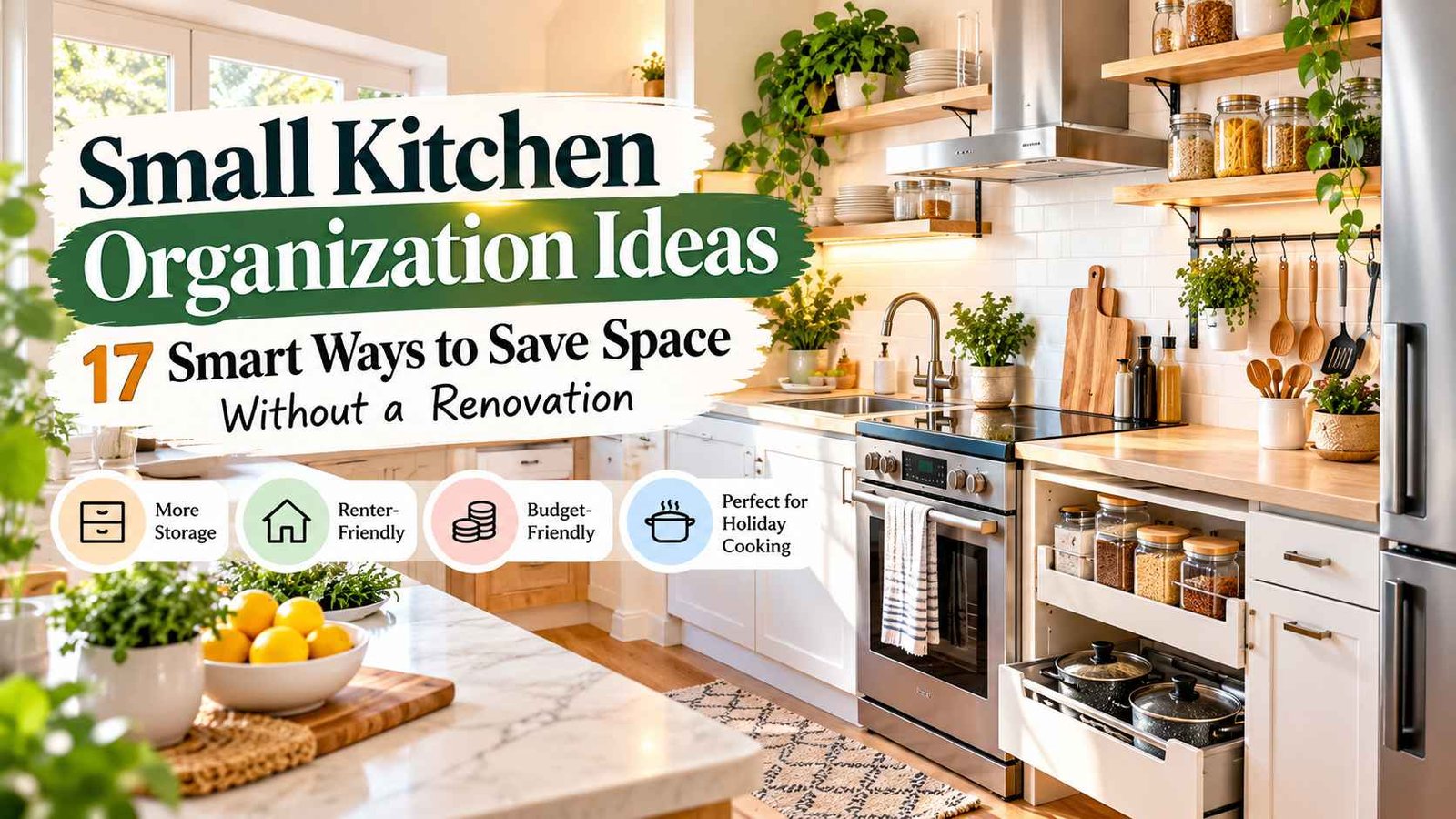
A practical, renter-friendly guide to making room for everyday cooking, groceries and holiday meals — without buying a pile of organizers.
A small kitchen can be perfectly usable until three things happen at once: someone brings home groceries, dinner needs chopping, and every available counter becomes a temporary shelf. The solution is not automatically another rack. It is a setup that gives everyday items a dependable home while keeping at least one work surface ready for food preparation.
The IKEA Store & Organize Report 2026 surveyed 31,488 people across 31 markets. In that survey, 24% identified kitchen countertops as the hardest area to keep free of clutter. That finding does not mean every kitchen needs to look minimalist. It shows why a workable system matters more than picture-perfect shelves.
QUICK ANSWER Start by protecting one clear prep area. Keep daily-use tools nearest the place they are used, put occasional items outside prime cabinet space, and add organizers only after measuring. For holiday cooking, create a temporary landing spot for groceries and a separate serving station.
Start With a 15-Minute Kitchen Map, Not a Shopping Cart
Before moving anything, observe one ordinary meal. Where do you put the grocery bag? Which cabinet do you open three times? What gets moved before you can use the cutting board? These answers reveal your actual storage needs. A tiny kitchen with one drawer needs a different plan from a galley kitchen with tall cabinets and a deep, awkward pantry.
Try this quick exercise: choose a section of counter that can stay available; identify the five objects you touch most often; then find the one cabinet or drawer where items are hardest to retrieve. Fix those three pressure points first. Think of the next 17 ideas as options, not a checklist of things you must buy.
17 Small Kitchen Organization Ideas Worth Trying
1. Give yourself a permanent prep zone
Pick the widest safe stretch of counter near the sink or cooking area, even if it is only large enough for a cutting board. Move mail, decorative jars and rarely used appliances off it. This is your kitchen’s “working lane”: the space that should not need emptying before dinner. When the area gets crowded, ask what has arrived without a home rather than stacking it more neatly. Avoid placing organizers next to hot burners or where they block appliance ventilation.
2. Sort by the job, not the object type
Instead of grouping every tool with similar-looking tools, set up simple activity zones. Keep a spatula and pan close to the cooking space; a knife, board and measuring tools near the prep zone; dish soap and cleaning cloths near the sink. A coffee or tea corner works if it stays compact. This shortens the number of times you walk across the kitchen or pull out unrelated items just to make one meal.
3. Use a “one reach” rule for everyday dishes
Daily plates, glasses and bowls deserve the easiest shelf. Holiday platters, extra mugs and special baking tins do not. Give the most reachable storage to what gets used every day and place light, occasional items higher up if they can be retrieved safely. Never depend on unstable chairs or climbing onto counters. If a cabinet is too high to reach comfortably, consider whether its contents belong somewhere else entirely.
4. Split tall cabinets into two usable levels
Many cupboards have enough height for two rows of cups but lack a practical second surface. A sturdy shelf riser can separate short dishes or mugs so you do not have to lift one pile to access another. Measure the interior height and the door clearance first, and respect the organizer’s load rating. A riser is a poor choice when it makes plates unstable or forces you to reach blindly to the back.
5. File flat equipment vertically
Baking sheets, cooling racks, pot lids and cutting boards become awkward when stacked flat. A suitable divider lets you slide out one piece without removing everything above it. Put the divider in a lower cabinet or a secure shelf with enough clearance. Keep heavier items stable and use a washable tray underneath if the storage surface is prone to crumbs or drips. The result is quicker access, not necessarily more possessions.
6. Make deep cabinets visible from the front
A deep shelf can hide a second layer of forgotten food behind everyday ingredients. Before buying a pull-out unit, group similar items in lightweight, easy-to-lift baskets with a clear label facing out. One basket might hold breakfast supplies; another might hold baking ingredients. If lifting the basket is uncomfortable, a properly fitted sliding shelf may help. Leave enough room to see what is behind the first row instead of packing the cabinet edge to edge.
7. Use drawer dividers that fit the drawer you own
Removable dividers work best when they match the shapes of your tools. For narrow drawers, keep only the cutlery and cooking utensils that genuinely belong there. Measure length, width and depth before buying, including the space taken by handles or rails. A smaller number of well-placed compartments usually feels easier than a complicated insert that leaves oddly shaped gaps you cannot use.
8. Keep a compact “first-use” pantry
A kitchen without a pantry does not need to hold months of supplies in plain sight. Reserve one accessible cabinet or shelf for ingredients you use every week: rice, pasta, breakfast staples, canned goods or frequently used spices. Keep back-up stock elsewhere in a suitable dry, clean area if available. Use clearly labelled containers only where the original packaging is inconvenient; preserve expiry dates, allergen information and cooking directions when decanting.
9. Reconsider the backs of cabinet doors
Lightweight over-door organizers can hold small wraps, cloths or cleaning accessories without permanent drilling. Check the door thickness, hinge movement and shelf clearance before adding anything. Heavy jars, glass containers or sharp items are better stored securely inside cabinets. Adhesive hooks also need a surface they are designed to hold; moisture and heat can weaken some adhesives. For renters, read the lease and removal instructions first.
10. Give every pot a predictable partner
Keep regularly used pans near their matching lids rather than storing lids in a random drawer across the room. A stable lid rack or adjustable cabinet divider can help, but simple nesting also works when pan surfaces are protected as recommended by the manufacturer. Store heavy cookware on strong, accessible shelves. The goal is to pull out one pan safely without rebuilding a tower of cookware afterward.
11. Choose a movable cart only if the walkway allows it
A narrow rolling cart can hold snacks, towels or baking supplies in a spare gap. Before choosing one, measure not only the gap but the door swing, appliance clearance and space needed to pass through the kitchen. Wheel locks and a stable design matter, especially in busy shared homes. If it makes you turn sideways to reach the sink, the cart has reduced the kitchen’s usefulness rather than improved it.
12. Create a clear, contained tea or coffee station
Kettles, mugs, tea bags and coffee supplies often spread over multiple counters. Keep the essentials together on one modest tray or shelf close to an appropriate outlet, while leaving appliance heat and ventilation clearances unobstructed. Extras can live in a nearby drawer. A good station has a natural boundary: when the tray fills, review what needs to stay instead of expanding across the counter.
13. Separate household clutter from cooking clutter
Not every object on the kitchen table belongs to the kitchen. Receipts, keys, chargers and school papers need their own landing place. In a Reddit conversation about cluttered kitchen tables, one commenter described using small individual bins to collect misplaced items before returning them to their proper rooms. That is a personal suggestion, not tested research, but it offers a useful principle: do not let food-preparation surfaces become the household’s lost-and-found.
14. Make under-sink storage easy to inspect
Use a washable tray or small bins under the sink to group sponges, spare cloths and cleaning products. Do not store food there or mix food with household chemicals. Keep hazardous cleaning supplies in original labelled containers, secured away from children and pets. Check periodically for leaks and avoid filling the area so tightly that plumbing is hidden. A small number of easy-to-remove bins makes cleaning and inspections simpler.
15. Treat unused wall space as a possibility, not a requirement
Freestanding shelves, suitable door racks or secure removable storage may help in a rental, but walls are not automatically free storage. Consider the mounting surface, manufacturer instructions, weight limits, landlord permissions and distance from heat or moisture. Avoid hanging heavy cookware or glass objects from unverified adhesive fixtures. A clean wall is often preferable to a storage idea that creates a new safety risk.
16. Give the refrigerator breathing room before a big meal
Holiday groceries can overwhelm a compact refrigerator. Remove expired items, plan dishes that can be prepared in advance and reserve space for ingredients that must stay cold. Store raw meat or poultry sealed on a lower shelf, away from ready-to-eat food. The FDA’s refrigerator storage guidance recommends 40°F (4°C) or below and warns against packing a refrigerator so tightly that air cannot circulate. A fridge thermometer is more useful than guessing from the dial.
17. Design a temporary serving station for guests
During holiday meals, guests need somewhere to put plates, drinks and finished dishes. Rather than filling the only prep surface, designate a dining table, sideboard or other stable, clean area for room-temperature serving items. Keep foods that need temperature control safely chilled or hot; do not treat the station as long-term storage for perishables. Return the station to its everyday purpose after the gathering instead of allowing it to become permanent overflow storage.
What Real Small-Kitchen Conversations Reveal
The same frustrations appear in several independent community discussions: too few drawers, too many mugs, deep cabinets that hide supplies and a wish to keep one counter clear. In a 2026 Reddit post about organizing a very tiny kitchen, the original poster described a kitchen with only three cabinets, one cupboard and one drawer. Another September 2026 kitchen-organization discussion raised the problem of high shelves and a deep pantry.
These are individual experiences, not representative studies. Still, they point to a useful question: Which part of your kitchen causes repeated work? If you have too many mugs, editing the collection may help more than another rack. If an ingredient disappears at the back of a cabinet, visibility may matter more than capacity. Fix the repeated inconvenience first.
Three Practical Setups for Different Small Kitchens
| Kitchen type | Most valuable first move | What to avoid |
| Studio with one short counter | Protect one prep section; move non-kitchen items to an entry basket | Filling the counter with decorative organizers |
| Galley kitchen with deep cupboards | Use labelled pull-out baskets and everyday-items-nearby zones | Stacking heavy cookware above shoulder height |
| Rental with no separate pantry | Create one weekly pantry shelf and store backups in a suitable dry space | Unsafe over-door loads or drilling without permission |
These are example layouts, not makeovers tested in specific homes. Adapt them to your kitchen dimensions, accessibility needs and household routines. A storage product should make your kitchen easier to use even on a busy weekday — not just improve a photograph.
A 30-Minute Kitchen Reset Before Holiday Cooking
When Thanksgiving, Christmas or a family dinner is approaching, a complete reorganization may be unrealistic. Use this focused reset instead:
- Minutes 0–5: Clear one food-preparation surface and move unrelated household items to their proper places.
- Minutes 5–10: Check the fridge, remove unsuitable or expired food, and identify space needed for perishables.
- Minutes 10–15: Group recipe ingredients together so you can spot what is missing before shopping.
- Minutes 15–20: Move special-occasion serving pieces somewhere accessible without blocking daily tools.
- Minutes 20–25: Empty the sink, wipe preparation surfaces and make room for clean-up.
- Minutes 25–30: Decide where guests will place drinks and dishes, then keep that space available.
For leftovers, the USDA guidance on safe food storage advises refrigerating perishable leftovers within two hours and generally using refrigerated leftovers within three to four days. For UK readers, government chilling and leftovers guidance recommends a fridge between 0°C and 5°C and eating leftovers within two days or freezing them. For Canadian readers, Health Canada’s safe food handling guidance recommends a refrigerator at 4°C (40°F) or lower. Always follow relevant local and product-specific instructions.
Small Kitchen Organization Mistakes That Waste Space
Buying bins before measuring is the classic mistake. Others include keeping every appliance on the counter, using the top shelf for a heavy daily-use pan, decanting everything into mismatched containers, and treating the oven as an extra cupboard. IKEA’s 2026 survey also reported that some respondents used ovens for storage; this is not a practice to copy, because items can be forgotten inside an appliance that is later switched on.
Another common mistake is moving clutter from one surface to another without giving it a real destination. If the kitchen table keeps filling up, consider whether the household needs a paperwork basket outside the kitchen. Storage works when it matches behavior. A beautiful system that takes too much effort to maintain is unlikely to last.
Frequently Asked Questions
How do I organize a small kitchen with almost no cabinets?
Use one accessible food shelf, an easy-to-reach place for everyday dishes and a protected prep surface. Where safe and suitable, consider a freestanding storage unit. Reducing duplicate equipment and keeping weekly essentials visible can be more effective than trying to store everything in the kitchen.
What should stay on a small kitchen counter?
Only items that earn their space through regular use and cannot be stored conveniently elsewhere, plus the area needed for preparing food. This might mean a kettle and one small utensil container in one home, but a mostly clear counter in another.
Are clear containers necessary for an organized pantry?
No. They can help you see some dry ingredients, but original packaging is often better for keeping product details and expiry information. Start by grouping similar foods before spending money on matching containers.
How do I organize a kitchen in a rented apartment?
Favor removable, correctly rated solutions such as shelf risers, drawer dividers, sturdy freestanding shelves and suitable over-door organizers. Check the lease and the product instructions before attaching anything to a wall, door or cabinet.
How should I organize a small kitchen before Thanksgiving or Christmas?
Make room in the fridge first, protect one prep area, group ingredients by meal and create a separate place for serving. Do not sacrifice food safety in order to fit extra dishes into a small refrigerator.
The Bottom Line
A better small kitchen is not necessarily a kitchen with more storage. It is a kitchen where the cutting board has somewhere to land, the everyday pan is easy to reach, and guests do not force you to move a week’s worth of clutter before cooking. Start with the one spot that delays you most. Make that spot work, live with the change for a few days, and only then decide whether another organizer is worth the space it takes.
Need an easy meal to make with the ingredients you already keep at home? Browse our simple Cuban recipes for home cooks for practical cooking ideas.