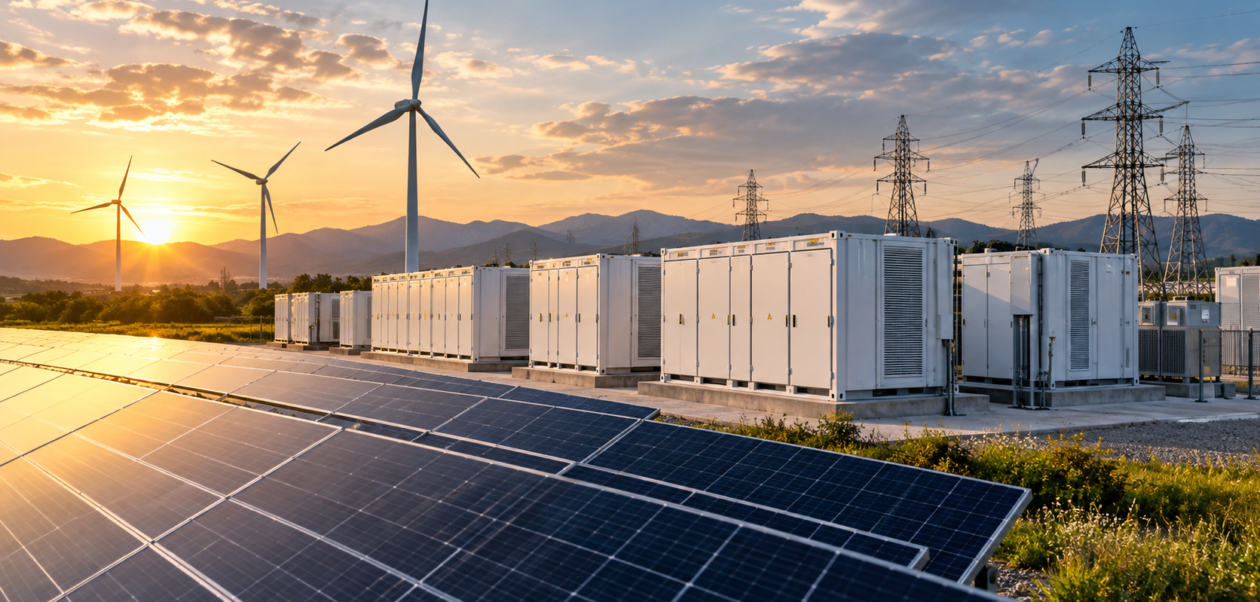
Battery storage news in 2026 is no longer a niche topic for energy specialists. Grid-scale batteries are moving from pilot projects into everyday power-system planning, while falling costs, renewable-energy growth, data-centre demand and changing grid rules are pushing battery energy storage systems (BESS) into more markets. The story is also becoming more diverse: lithium iron phosphate (LFP) remains dominant, but sodium-based systems, long-duration storage and second-life batteries are getting serious attention.
The scale of the shift is clear in the International Energy Agency’s latest battery storage analysis. The IEA reports that 108 GW of new battery storage capacity was deployed worldwide in 2025, about 40% more than in 2024. Around four-fifths of new capacity was utility-scale, LFP chemistry represented roughly 90% of deployments, and China accounted for about 60% of global additions. Those numbers explain why battery storage is now one of the fastest-moving parts of the power sector.
Battery Storage News at a Glance
| Update | What happened | Why it matters |
| Global market | 108 GW of new battery storage capacity was deployed in 2025. | Shows storage has moved into a major infrastructure role. |
| United States | Operational utility-scale storage reached nearly 52 GW by mid-2026. | Large projects are becoming a core part of grid planning. |
| Australia | First grid-connected sodium-sulfur BESS began operating in Brisbane in September. | Non-lithium long-duration technologies are gaining real-world exposure. |
| Germany | Vattenfall advanced a 1 GWh battery project at the former Brunsbüttel nuclear site. | Old energy sites are being reused as flexible grid assets. |
| Pakistan | NEPRA approved a storage requirement for a renewable-energy auction framework. | BESS is entering formal renewable procurement policy in Pakistan. |
Global Battery Storage Is Growing at Record Speed
Battery storage has become valuable because modern grids need flexibility. Solar output is strongest in daylight hours, wind can change quickly, and electricity demand often peaks at a different time from renewable generation. Batteries can charge when power is plentiful and discharge when the grid needs it most. They can also respond quickly to frequency changes and local congestion.
The IEA says installed battery storage capacity is now about eleven times higher than it was in 2021. Most new systems are still designed for relatively short durations, but project durations are gradually getting longer as grids add more solar and wind. This matters because the role of storage is expanding from fast balancing into multi-hour shifting of electricity.
Source: IEA — Global Energy Review 2026: Battery Storage
Figure 1. Key global battery-storage metrics reported by the IEA for 2025.
Latest Battery Storage Projects Making News in September 2026
Australia connects its first grid sodium-sulfur BESS
On September 14, Australia’s first grid-connected sodium-sulfur battery storage system began operating in Brisbane. The 250 kW / 1.45 MWh system is small compared with giant lithium-ion projects, but the technology angle is important: it gives another long-duration chemistry a real grid-connected demonstration in the Australian market. Read the project report.
Germany moves ahead with a 1 GWh battery at a former nuclear site
Vattenfall is moving forward with a 1 GWh BESS at the former Brunsbüttel nuclear power plant site in Germany. Reusing existing energy locations can be attractive because they may already have valuable grid infrastructure and a long history as power-system sites. The project is also a good example of storage being treated as a flexibility asset rather than simply a backup battery. See the latest Brunsbüttel BESS update.
Texas adds a 160 MW / 320 MWh project
In the United States, SMT Energy and FlexGen announced operations at the Houston IV project, a 160 MW / 320 MWh BESS in Texas. ERCOT has become one of the most closely watched battery markets because rapid load growth, strong renewable generation and price volatility create several ways for storage to provide value. Read the Texas project report.
India plans a 12 GWh BESS manufacturing facility
Battery storage growth is also reshaping manufacturing. Premier Energies and RCT India announced a joint venture for a planned 12 GWh BESS manufacturing facility in Telangana, with a first phase planned at 6 GWh. This is a reminder that the storage race is not only about project deployment; countries also want local manufacturing, supply-chain capability and export potential. Read the India manufacturing update.
Pakistan puts storage into renewable-auction planning
Pakistan also entered the 2026 battery-storage news cycle with a significant policy step. In early September, NEPRA approved changes to a renewable-energy auction framework that include a mandatory co-located BESS requirement for participating wind and/or solar generation. The framework relates to an 800 MW aggregated renewable-energy procurement process. For Pakistan, this is important because storage can help renewable projects deliver power more predictably and can reduce some of the operational challenges caused by variable generation. Read the Pakistan policy update.
U.S. Battery Storage Growth Is Still Accelerating
The United States remains one of the largest battery-storage markets. In February, the U.S. Energy Information Administration said developers planned to add 24 GW of utility-scale battery storage during 2026, compared with a record 15 GW added in 2025. Texas, California and Arizona represented most of the planned additions. EIA’s 2026 capacity outlook provides the project-level context behind that expansion.
The trend continued through the first half of the year. In August, EIA reported that the United States had 43.6 GW of operational utility-scale battery storage at the end of 2025. Another 8.3 GW was added during the first six months of 2026, taking nameplate capacity to nearly 52 GW. Operators also reported a large pipeline of additional projects for the following years. See the August 2026 EIA update.
Figure 2. U.S. utility-scale battery storage capacity at end-2025 and mid-2026, based on EIA reporting.
Why LFP Batteries Still Dominate BESS
Lithium iron phosphate has become the default chemistry for many stationary battery projects. The reason is not simply energy density. A grid battery usually stays in one place, so developers care strongly about cost, cycle life, thermal behaviour, warranty terms and the ability to charge and discharge frequently. The IEA estimates that LFP represented around 90% of battery-storage deployments in 2025.
That does not mean one chemistry will win every storage application. Stationary systems can tolerate more weight and volume than electric vehicles, which creates room for alternatives when those technologies offer lower cost, longer duration, improved safety characteristics or a different supply chain.
Sodium-Ion, Sodium-Sulfur and Long-Duration Storage Are Moving Closer to the Mainstream
Sodium-based batteries are receiving more attention because sodium is abundant and stationary storage does not require the same energy density as a vehicle battery. However, the technology should not be oversold. The IEA notes that sodium-ion manufacturing capacity and supply chains remain much smaller than those for lithium-ion. That makes near-term scale a challenge even when the chemistry looks promising for stationary applications. IEA’s 2026 battery technology assessment highlights both the potential and the current limitations.
The most realistic 2026 view is that lithium-ion, especially LFP, remains the market leader while sodium-ion, sodium-sulfur, flow batteries, iron-air systems and other long-duration approaches compete for specific use cases. Grid storage does not need one universal chemistry. A two-hour project supporting daily price swings has different needs from a system designed to cover long periods of renewable shortfall.
Battery Storage Costs: The Long-Term Trend Is Down, but Prices Can Still Move
Cost has been one of the biggest reasons behind the storage boom. The IEA reports that average lithium-ion battery pack prices fell by around 20% in 2024 and then by another roughly 8% in 2025. Lower equipment costs can improve project economics, but a complete BESS budget includes much more than battery cells. Developers also have to pay for inverters, transformers, containers, cooling, fire protection, controls, construction, land, grid connection and financing.
That is why a headline about cheaper cells does not automatically mean every storage project becomes cheaper at the same speed. Regional supply chains, tariffs, interconnection costs and financing conditions can all change the final economics. IEA’s Electricity 2026 flexibility analysis gives a broader view of these market drivers.
AI and Data Centres Add Another Layer of Storage Demand
Rapid data-centre expansion is increasing electricity demand in several regions. Batteries can support data-centre power quality, short-duration backup and grid interaction, although data-centre UPS systems are not the same thing as utility-scale BESS. The IEA reported strong growth in battery-based UPS capacity in 2025, showing how rapidly large digital facilities are adding battery equipment alongside the expansion of AI computing.
For the wider power system, the more important question is how grids will serve large new loads without creating reliability problems. Storage can help, but it works best as part of a wider package that includes generation, transmission, demand flexibility and stronger grid connections.
The Biggest Challenges: Grid Connections, Permitting, Revenue and Safety
Battery storage can be built faster than many conventional power plants, but projects can still spend years waiting for grid access or planning approval. The IEA describes grid connection queues as a major bottleneck for new generation, demand and storage. In many markets, the constraint is no longer whether developers want to build batteries; it is whether the network can connect them in time. See the IEA’s grid bottleneck analysis.
- Grid connection delays can hold up projects even after land and financing are secured.
- Permitting and local planning can become difficult when communities have concerns about fire safety or land use.
- Revenue can be volatile because batteries may earn money from several changing markets, including energy trading and grid services.
- Financing depends on warranties, degradation assumptions, cycling strategy and long-term expectations for electricity prices.
- Software and controls matter as much as hardware because the value of a BESS depends on when and how it charges and discharges.
Is Battery Energy Storage Safe?
Modern BESS projects are designed with multiple layers of protection, including battery-management systems, thermal monitoring, ventilation, isolation, fire detection and emergency procedures. Even so, no large energy asset is risk-free. Fire-safety planning remains a real issue for developers, regulators and nearby communities, especially as project sizes increase.
A balanced article should avoid two extremes: claiming that battery systems are inherently unsafe, or pretending that incidents cannot happen. The better approach is to look at chemistry, system design, site layout, operating procedures, codes, maintenance and emergency response together.
Battery Storage Is Becoming a Global Infrastructure Market
China continues to lead global deployment, while the United States and Europe remain major markets. Australia has become particularly important for large grid batteries because of its high renewable penetration and volatile wholesale market. India is expanding both deployment and manufacturing. The Middle East is also moving quickly as countries combine large solar projects with storage.
In Europe, storage is increasingly being developed at existing industrial and power sites. In Sweden, Volvo Group announced plans in September for a large-scale battery storage facility in Mariestad that will also work as a test platform for future energy solutions. Reuters reported the Volvo project on September 10, 2026.
What Battery Storage Communities Are Discussing
Industry reports tell us what is being built; community discussions reveal what buyers and enthusiasts are uncertain about. Recent Reddit discussions around sodium-ion storage show a useful split. Some users are excited about the possibility of cheaper materials and good stationary-storage performance, while others remain skeptical until real products are widely available at prices below mature LFP systems. One recent EnergyStorage discussion captures that gap between technical potential and what consumers can actually buy today.
That distinction is important for good battery storage news coverage. Community posts can help identify questions and concerns, but claims about performance, safety, costs or market size should still be checked against technical documents, regulators and primary data before publication.
What Comes Next for Battery Storage?
The next phase of the battery-storage market will probably be less about proving that batteries work and more about deciding where they create the most value. Short-duration LFP systems are already established. The growth areas now include four-hour-plus systems, grid-forming inverters, storage paired with solar and wind, merchant optimisation, local manufacturing, non-lithium chemistries and more sophisticated software.
The strongest signal in 2026 is that storage is being treated as infrastructure. Governments are writing it into procurement rules, utilities are planning it alongside power plants and transmission, and industrial companies are developing storage at their own sites. That makes battery storage news relevant not only to clean-energy readers, but also to investors, grid operators, manufacturers, policymakers and businesses planning for electricity reliability.
FAQs About Battery Storage News
What is battery storage?
Battery storage captures electrical energy so it can be used later. Grid-scale systems usually charge when electricity is abundant or cheaper and discharge when demand or grid value is higher.
What does BESS mean?
BESS stands for Battery Energy Storage System. It normally includes battery cells or modules, power-conversion equipment, thermal management, controls, safety systems and a grid connection.
Why is battery storage growing so fast?
Growth is being driven by renewable-energy expansion, lower battery costs, grid flexibility needs, electricity-price volatility and the need to connect more variable solar and wind generation.
Which battery chemistry is most common for grid storage?
LFP is currently the dominant chemistry for new battery-storage deployments because it offers a strong mix of cost, cycle life and suitability for stationary use.
Are battery storage prices falling?
The long-term trend has been downward, although project costs can move differently by region. Equipment prices are only one part of the total cost of a grid battery project.
Will sodium-ion replace lithium-ion batteries?
Not in the near term. Sodium-ion has promising characteristics for stationary storage, but its manufacturing base and supply chain are still much smaller than lithium-ion.
How long can grid batteries store electricity?
Many current projects are around two hours, but four-hour and longer systems are becoming more common. The right duration depends on the market and the job the battery needs to perform.
Is battery energy storage safe?
BESS projects use layered safety systems, but they still require careful design, monitoring, maintenance, fire planning and emergency procedures.
Why are Texas and California important battery markets?
Both states have large renewable fleets, significant electricity demand and grid conditions where flexible storage can provide valuable services.
What is the outlook for battery storage in 2027?
The project pipeline suggests continued growth, with more large-scale systems, longer durations, new chemistries and tighter integration between batteries, renewables and grid operations.