
If you are selling, buying, or researching a property in the UK, the term Home Information Pack can be confusing. You may still see it in old property guides and search results. However, the original HIP system no longer applies in England and Wales.
The idea behind a Home Information Pack has not disappeared. In fact, the UK government is again looking at ways to give buyers important property information earlier.
The key point is simple: sellers in England and Wales do not need an old-style Home Information Pack in 2026. The legal duty was suspended in May 2010 and later repealed. However, an Energy Performance Certificate (EPC) is still normally needed when a home is marketed for sale.
In June 2026, the UK government also published a new reform roadmap. It proposes a future standardised sales pack that could be prepared before a property is listed.
This guide explains what a Home Information Pack was, what it included, what sellers need today, and what could change next. It also uses current UK government guidance, EPC information, Scottish Home Report guidance, and buyer discussions for context.
Quick answer: Home Information Packs were compulsory for most residential property sales in England and Wales from 2007 until 2010. Sellers do not need an old-style HIP today. However, they still have EPC and property-information responsibilities. The government is also planning a new upfront sales-pack system for the future.
What Is a Home Information Pack?
A Home Information Pack, usually called a HIP, was a group of documents used when selling a home in England or Wales.
The purpose was straightforward. Buyers were meant to receive useful information earlier in the process. As a result, they could review important details before spending too much time or money on a purchase.
The HIP requirement was introduced in stages during 2007.
According to GOV.UK’s record of the 2010 suspension, sellers and estate agents no longer had to provide a HIP from 21 May 2010.
Later, the Localism Act 2011 repealed the Home Information Pack provisions in Part 5 of the Housing Act 2004.
What Did a Home Information Pack Include?
The exact contents of a HIP could vary. However, the pack usually focused on standard property, legal, and energy information.
Typical documents included an Energy Performance Certificate, title information, property searches, and a sale statement. In addition, leasehold or commonhold homes could need extra documents.
| Former HIP component | Why it mattered |
|---|---|
| Energy Performance Certificate (EPC) | Showed the home’s energy-efficiency rating and possible improvements. |
| Title information | Helped confirm ownership and registered title details. |
| Searches | Could include local authority, drainage, water, and other location information. |
| Sale statement | Summarised basic details about the property and the sale. |
| Leasehold/commonhold documents | Added information about the property’s tenure where relevant. |
These are historical HIP components. Therefore, they should not be treated as a current checklist for every seller in England and Wales.
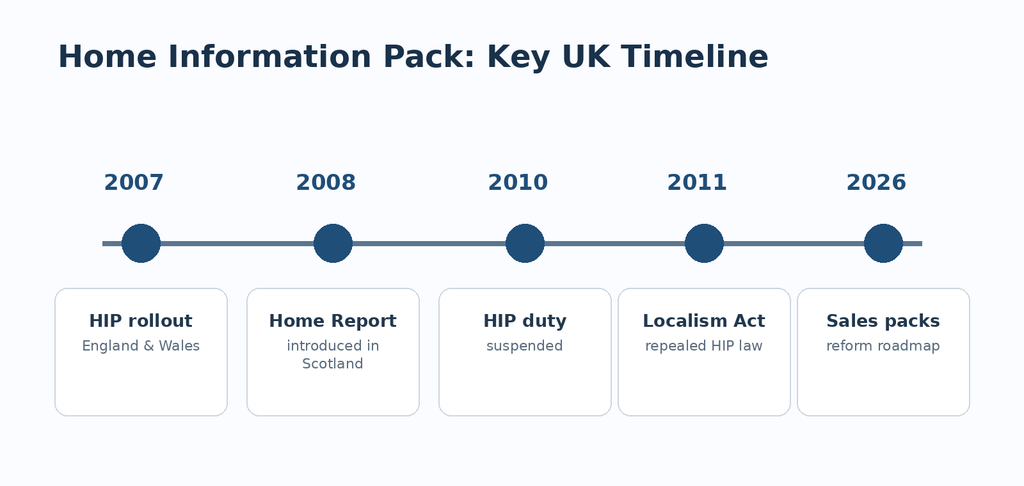
Timeline: from HIPs to the 2026 sales-pack reform roadmap.
When Were Home Information Packs Abolished?
The compulsory HIP duty was suspended in May 2010.
At that point, sellers could market a property without first providing a Home Information Pack. However, the EPC requirement remained.
The legal framework was later removed through section 183 of the Localism Act 2011. You can review the legislation directly in the Localism Act 2011.
Therefore, the old HIP system should be treated as part of UK property history rather than a current selling requirement.
Why Were Home Information Packs Scrapped?
Several concerns were raised about HIPs.
One issue was cost. Sellers had to prepare information before putting a property on the market. That created an extra upfront expense.
Another issue was trust. Some buyers were unsure whether they should rely on information arranged by the seller.
There were also concerns about duplication. For example, buyers or lenders could still ask for their own checks.
A 2010 government statement also discussed buyer concerns about property-condition information. Therefore, the government decided to remove the compulsory HIP requirement.
This history still matters today. Any future sales-pack system must make information early, clear, current, and trusted.
Do You Need a Home Information Pack to Sell a House in 2026?
No, not in England and Wales.
You do not need the old-style Home Information Pack. However, that does not mean a seller has no paperwork to prepare.
For example, an Energy Performance Certificate is still normally required before a home is marketed.
Current GOV.UK EPC guidance says a property being sold normally needs an EPC. If there is no valid certificate, the seller should order one before marketing begins.
An EPC shows the energy efficiency of a property from A to G. It is generally valid for 10 years.
What Sellers Should Prepare Today
Instead of looking for an old HIP provider, sellers should focus on becoming sale ready.
Preparing important documents early can reduce delays later. It can also help a conveyancer answer buyer questions more quickly.
Useful documents may include:
- A valid EPC
- Title-related paperwork
- Planning or building-regulation documents
- Guarantees or warranties
- Leasehold information
- Service-charge details
- Information about alterations
- Property forms requested by the conveyancer
The government’s How to sell a home guide also recommends gathering paperwork early.
As a result, important information can be shared sooner and delays may be easier to avoid.
Are Home Information Packs Coming Back?
Not under the old HIP name.
However, the policy direction in 2026 is moving toward more upfront property information.
The Home Buying and Selling Reform Roadmap, updated on 19 June 2026, says the government plans to identify information that can be provided earlier in the sale process.
It also says that, when parliamentary time allows, legislation could require a standardised sales pack before a property is listed.
The proposed pack is expected to include searches and a property-condition report.
Importantly, this is a planned reform. It is not yet the same as a current legal duty for every seller.
What Could the New Property Sales Pack Include?
The final rules may still change. However, the 2026 roadmap gives a useful picture of what could be included.
Possible information includes:
- Tenure type, such as freehold or leasehold
- Council Tax band
- EPC rating
- Property type
- Floor plan
- Title documents
- Known covenants
- Seller identity verification
- Leasehold or managed-freehold charges
- Building-safety information
- Standard property searches
- A general property questionnaire
- A property-condition assessment
- Accessibility information
- Chain status
If these reforms become law, more due diligence would happen before or around the listing stage.
As a result, buyers could understand a property earlier. Sellers could also discover missing information before an offer is accepted.
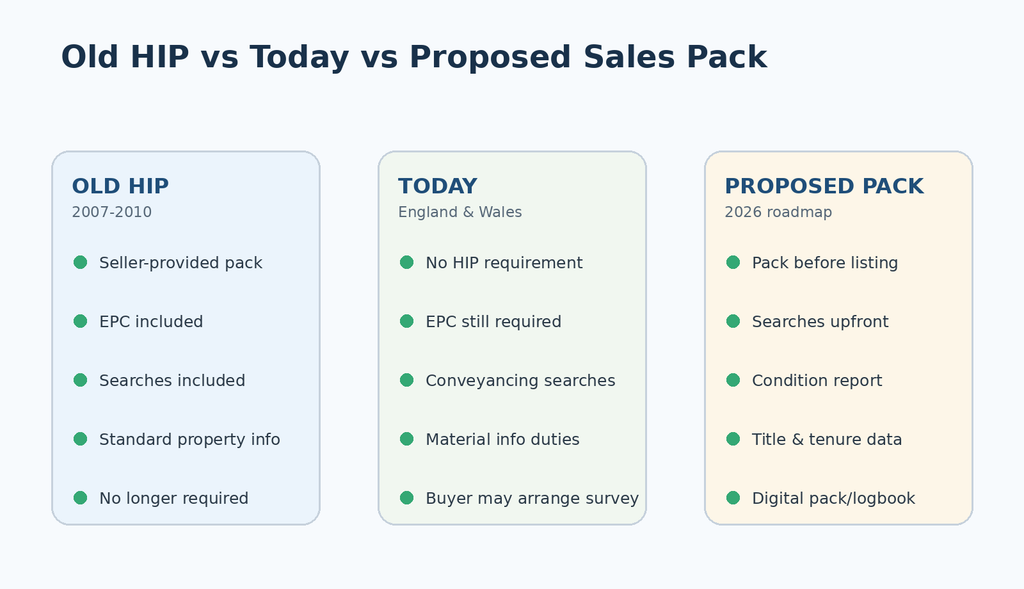
Visual comparison: old HIP, the current process, and the proposed sales pack.
Home Information Pack vs Proposed Sales Pack
The easiest way to understand the difference is to separate the old system from the new proposal.
The old HIP was a specific legal product. By contrast, the proposed sales pack forms part of a wider reform programme.
That programme also includes better material information, digital property records, and earlier preparation.
| Feature | Old HIP | Current England/Wales | Proposed sales pack |
|---|---|---|---|
| Status | Historic and repealed | No HIP duty | Planned legislation |
| When prepared | Before or at marketing | Documents gathered during the sale process | Before listing |
| EPC | Part of the HIP | Normally still required | Expected within the data set |
| Searches | Included in the HIP framework | Usually handled during conveyancing | Planned upfront |
| Condition information | Limited and debated | Buyer often arranges a survey | Condition assessment planned |
| Digital logbook | Not central to HIPs | Optional products exist | Part of wider reform plans |
What Is Material Information in a Property Listing?
Material information is related to the same goal, but it is not the same thing as a Home Information Pack.
In simple terms, material information is information that may affect a buyer’s decision.
For example, tenure, ongoing charges, restrictions, and important property characteristics may influence whether someone wants to continue with a purchase.
The government’s material information consultation outcome explains why clearer information is needed earlier in the process.
Therefore, sellers and agents should avoid leaving important facts until the final stages of a transaction.
Home Information Pack vs Scotland’s Home Report
Scotland uses a different system.
The Scottish Home Report was introduced in 2008 and remains part of the Scottish home-selling process.
According to the Scottish Government’s Home Reports guidance, the Home Report is designed to give buyers useful information before they make an offer.
It normally includes:
- A Single Survey
- An Energy Report
- A Property Questionnaire
This distinction matters for search intent. Some users search for “home information pack Scotland.” However, the modern Scottish term is generally Home Report.
What Buyers Should Check Before Relying on a Property Pack
A property pack can be useful. However, buyers should still check who produced the information and when it was prepared.
For example, a search can become outdated. A condition report may also have limits.
In addition, a lender may have different requirements from the buyer.
Therefore, a pack should be treated as a tool for better transparency. It should not be treated as a guarantee that no extra inspection or professional advice will ever be needed.
What Real Buyers Are Discussing
Buyer discussions show why this topic remains important.
On HousingUK, users often ask why sellers do not provide more information before an offer. Some also ask why recent searches or surveys cannot always be reused.
Other users compare England and Wales with Scotland’s Home Report system.
These comments are anecdotal. Therefore, they should not be used as legal evidence.
However, they do reveal a clear search intent. Buyers want to know what information they can trust, who should pay for it, and when it should become available.
For an example, see this HousingUK discussion about seller packs, surveys and searches.
For legal and policy claims, official government sources should still be the main reference.
Will the New Sales Pack Make Buying a Home Faster?
That is the government’s aim.
The June 2026 roadmap says the current process can take a long time after an offer is accepted. It also says a significant number of transactions fail before completion.
The proposed reforms aim to provide key information earlier. Therefore, buyers and sellers may be able to identify problems sooner.
However, the final result will depend on implementation.
Important questions still remain. For example:
- How long will searches remain acceptable?
- Will lenders accept seller-commissioned information?
- How will condition reports be standardised?
- Who will pay for the pack?
- How will the information be updated?
The government says the transition will be phased. Therefore, sellers should follow current rules until new legislation is introduced.
What Sellers Can Do Now
Sellers do not need to wait for future reforms.
They can already prepare for a smoother sale.
First, check whether the property has a valid EPC.
Next, speak with a conveyancer early. Then gather title documents, leasehold information, guarantees, approvals, and records of major alterations.
Finally, answer property questions accurately.
The goal is not to recreate an old Home Information Pack. Instead, the goal is to reduce delays and make important information easier to find.
Frequently Asked Questions
Do I need a Home Information Pack to sell my house in 2026?
No. Sellers in England and Wales do not need the old-style HIP. The duty was suspended in 2010 and later repealed.
However, you still need to follow current selling requirements. In most cases, that includes having a valid EPC and providing accurate property information.
When were Home Information Packs abolished?
The compulsory duty was suspended from 21 May 2010.
Later, the Localism Act 2011 repealed the legal provisions behind the HIP system.
Is an EPC the same as a Home Information Pack?
No.
An EPC was one part of the old HIP system. However, EPCs remain a separate current requirement for most homes being sold or rented.
What did a Home Information Pack include?
A HIP usually included an EPC, title information, searches, and a sale statement.
Leasehold or commonhold properties could also need extra documents.
Are Home Information Packs coming back?
Not in their old form.
The government’s 2026 roadmap proposes a new standardised sales pack before listing. However, legislation is still planned for a future stage.
What will the new sales pack contain?
The government currently expects the pack to include important property information.
This may include tenure, Council Tax band, EPC details, title documents, searches, a property questionnaire, a condition assessment, chain status, and a floor plan.
However, the final requirements may change before legislation is introduced.
Does Scotland use Home Information Packs?
Scotland uses a different system called the Home Report.
It normally includes a Single Survey, an Energy Report, and a Property Questionnaire.
How long is an EPC valid?
An EPC is generally valid for 10 years.
You can check the official register to see whether a valid certificate already exists.
Can a buyer still get their own survey?
Yes.
Even if a future sales pack includes a condition report, a buyer may still choose a more detailed survey. A lender may also have its own requirements.
Is a legal pack the same as a HIP?
Not necessarily.
Some sellers or agents provide legal packs with title documents and searches. However, that does not make them a statutory Home Information Pack under the old system.